Examining the structures behind the pressure to perform online, and imagining alternatives
Initial research question
How has the platform-based content economy transformed everyday self-expression and communication, and how might we evolve to re-centre connection, nuance, and meaning within a system optimized for metrics and monetization?
We used to live and share. Increasingly, we live to share. The places we go and the pictures we take are chosen with one question in mind: how will this look on my feed?
Reframed research question
What systemic forces cause and sustain the shift from connection to performance in digital content culture, and what conditions would enable a different system to emerge?
The first question asked how we might adapt inside the system. The research kept pointing past that. The usual answer to social media’s harms is individual: curate your feed, take a break, log off. But participation is tied to employability, to staying connected across distance, and to how social life now works, so opting out carries real social and professional cost. So I stopped asking how individuals can cope and started asking what holds the system in place.
How I worked
The research followed the Double Diamond:
- Discover: a literature review spanning platform economics, algorithmic governance, performativity and generative AI; netnographic observation of public discourse on X; and nine in-depth interviews with participants across six countries.
- Define: thematic and stakeholder analysis, Causal Layered Analysis, and system mapping.
- Develop: signals and drivers of change, Dator’s four generic futures for 2045, and backcasting from the preferred one.
- Deliver: interventions mapped to Meadows’ leverage points.
What I found
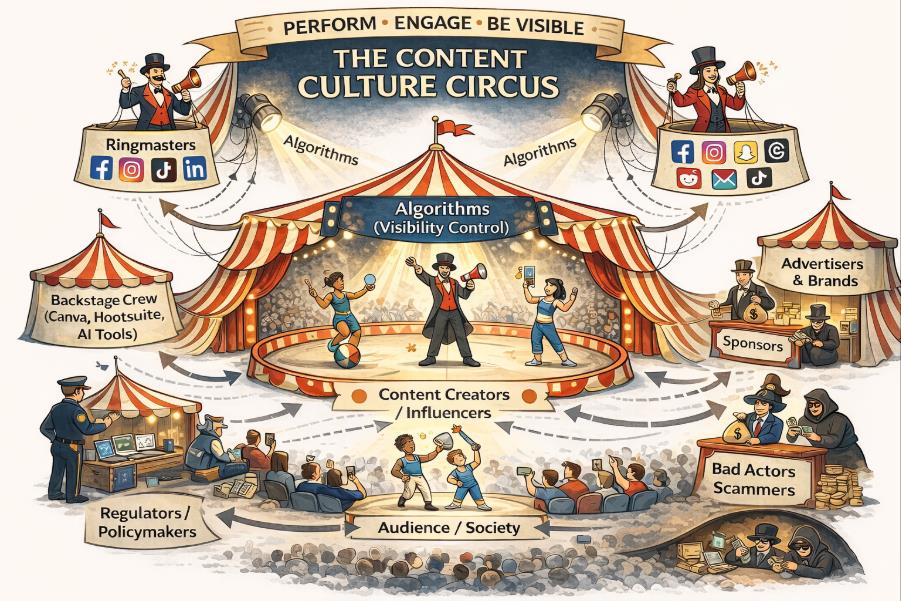
The shift isn’t accidental, inevitable, or mainly a matter of individual behaviour. It’s structural. The system mapping showed three reinforcing loops (performance pressure, algorithmic amplification and monetisation) and one balancing loop, the erosion of trust and authenticity, that isn’t yet strong enough to slow them. Beneath them, the Causal Layered Analysis surfaced the myth holding it all in place: to be seen is to exist.
But most people aren’t performers. Many participants described themselves as “ghost users,” watching far more than they post. And both the interviews and the online observation surfaced something that matters for change: widespread, articulate fatigue. People can name how the system works and still feel its pull. That gap, between what people put up with and what they believe is legitimate, is where change starts.
Four futures, one direction
I developed four scenarios for content culture in 2045: The Glass Stage (continued growth), The Empty Circus (collapse), The Visible Hand (discipline) and The Commons (transformation). The Commons is the preferred future. It isn’t a utopia; it’s a direction, from to be seen is to exist toward to connect is to belong, with digital connection governed by communities rather than platforms.
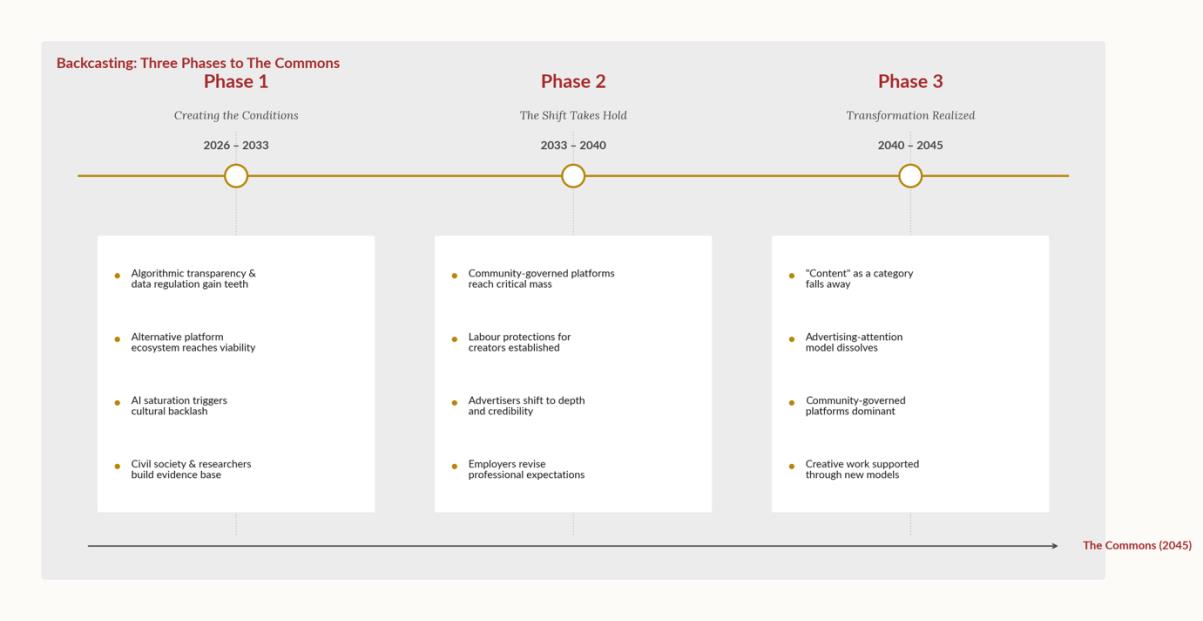
Backcasting mapped three phases to get there:
- 2026–2033, creating the conditions: regulation with real teeth, credible alternative platforms, and burnout recognized as a structural problem, not a personal failing.
- 2033–2040, the shift takes hold: alternatives reach critical mass, creators gain labour protections, and employers stop equating visibility with value.
- 2040–2045, transformation: even the word “content” falls away. People make things and share them.
Most people who started using these platforms didn’t sign up to perform. They signed up to connect. This research argues they shouldn’t have to settle for less.
The talk
The research informed a TEDx talk, The Cost of Being Seen.
Dania Idam. Major Research Project, MDes in Strategic Foresight and Innovation, OCAD University, 2026. Principal Advisor: Michele Mastroeni. Read the full MRP

